


Overview
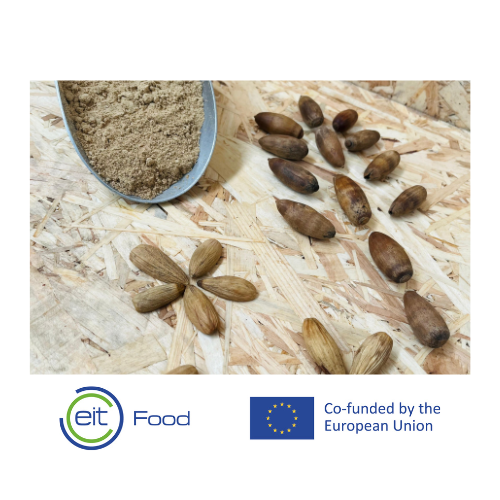
"Integration of Acorn Flour into the Food Chain as an Ingredient with High Nutritional Value" is a food innovation project focused on integrating acorn flour into products for the B2B and B2C markets. Coordinated by LandraTech, the project aims to transform acorns, an abundant but still underutilised natural resource, into sustainable, high-value food ingredients.
The initiative follows previous EIT Food-supported work exploring roasted acorn flour as a coffee substitute. This new phase moves beyond initial validation towards industrial development, production scale-up and market introduction across several food applications.
Context and Identified Problem
Portugal and Spain have extensive areas of Quercus woodland, including montado and dehesa systems, which produce significant quantities of acorns every year. However, much of this resource is still used only for animal feed or remains economically unexploited. At the same time, the food industry is seeking new ingredients that respond to increasing demand for plant-based, naturally gluten-free and fibre-rich products produced through more sustainable processes.
The industrial use of acorn flour nevertheless remains limited by its restricted presence in conventional food value chains, the need for formulations adapted to specific applications, limited large-scale production and packaging capacity and low market awareness of its potential. The project addresses these limitations by combining product development, industrial validation, packaging capacity, traceability, environmental assessment and commercialisation.
Objectives
The main objective is to develop, validate and commercialise acorn-based food products, strengthening their integration into European food value chains. The project aims to:
- Refine the formulation of a caffeine-free acorn coffee substitute;
- Adapt the coffee substitute to capsule packaging;
- Install and validate a packaging line for larger-scale production;
- Develop acorn-flour formulations for bread and cookies;
- Develop formulations for plant-based hamburgers and sausages;
- Perform quality, stability and shelf-life testing;
- Validate the formulations at pre-industrial scale;
- Collect and integrate customer and consumer feedback;
- Prepare the products for B2B and B2C commercialisation;
- Implement a traceability system;
- Develop marketing and communication strategies;
- Assess the environmental impact of the products through a life-cycle assessment;
- Identify opportunities to improve the sustainability of the production processes.
Product Development and Innovation
The project is structured around three main development areas.
1. Acorn coffee substitute
Roasted acorn flour will be used to produce a naturally caffeine-free coffee substitute commercialised by LandraTech under the Armazém da Bolota brand. The project covers recipe refinement, adaptation to coffee machines, pre-industrial batch production, quality and shelf-life testing and the development of capsule packaging. The solution builds on a previously validated product and aims to reach TRL 9, making it ready for commercialisation and expansion in the European market.
2. Bakery applications
Acorn flour will be incorporated into formulations for bread and cookies. In collaboration with Blendhub, the project will conduct market and feasibility studies, recipe development, laboratory testing, pre-industrial production, quality assessment and validation with potential customers. The formulations will be adjusted according to technical results and market feedback, preparing them for introduction into the B2B bakery sector.
3. Plant-based meat alternatives
The project will also develop acorn-flour formulations for plant-based hamburgers and sausages. Acorn flour will be assessed as an ingredient contributing to the texture, structure and nutritional differentiation of these products. The recipes will be tested at laboratory and pre-industrial scales, followed by quality, stability and customer-acceptance assessments. The objective is to advance these applications from TRL 4 to TRL 9, creating solutions ready for industrial commercialisation.
Packaging Line, Traceability and Industrial Scale-Up
A central component of the project is the acquisition, installation and validation of a packaging line supporting the production and distribution of acorn-based products. This capacity will enable LandraTech to:
- Package the coffee substitute in capsules;
- Respond to larger orders;
- Ensure greater uniformity and quality control;
- Train the employees responsible for packaging operations;
- Establish standard operating procedures;
- Prepare the transition to industrial-scale production.
The project also includes the implementation of a traceability system designed to increase supply-chain transparency, from the origin of the acorns to the final product. This component will support clearer communication regarding raw-material sourcing, processing methods and the sustainability attributes associated with the products.
Environmental Assessment
IRTA will conduct a life-cycle assessment covering the products and processes developed during the project. The assessment will examine the different stages of the value chain, including raw-material supply, processing, packaging and distribution. The study will:
- Quantify the main environmental impacts;
- Identify the stages contributing most to the overall impact;
- Assess the carbon footprint and resource use;
- Identify waste-reduction opportunities;
- Recommend improvements to the production processes;
- Provide environmental information for industrial customers;
- Support the sustainable positioning and communication of the products.
The results will be incorporated into LandraTech’s continuous-improvement strategy and used to support customers in achieving their sustainability objectives.
Impact and Contribution
The project contributes to a more circular, sustainable and resilient food system by valorising a forest resource that has traditionally been underused. Creating new food applications for acorns may increase demand for this raw material and generate economic opportunities for forest owners, producers, collectors and processing companies in Portugal and Spain.
For the food industry, acorn flour represents a differentiated ingredient for the development of plant-based and naturally gluten-free products, while also providing fibre and antioxidant compounds. The project aims to:
- Reduce the underuse of acorns;
- Create economic value from local resources;
- Increase the availability of sustainable food ingredients;
- Strengthen the competitiveness of the agri-food industry;
- Diversify the supply of caffeine-free and gluten-free products;
- Create new B2B and B2C revenue streams;
- Support the sustainability objectives of food manufacturers;
- Promote more transparent supply chains;
- Strengthen the connection between Quercus woodlands and industry;
- Prepare LandraTech’s products for expansion into additional European markets.
The project is aligned with the EIT Food missions of delivering healthier lives through food, supporting a net-zero food system and reducing risk for a fair and resilient food system.
Project Information
Programme: EIT Food - Innovation Call 2024/2025
Funder: European Union, through EIT Food
Grant Agreement: BP 2023-25
Project KAVA Number: 250679
Proposal ID: 24290
Project Title: Integration of Acorn Flour into the Food Chain as an Ingredient with High Nutritional Value
Total Investment: €945,500.00
EIT Food Funding: €661,850.00
Consortium Co-funding: €283,650.00
Funding Rate: 70%
Duration: 18 months
Start Date: 1/07/2025
End Date: 31/12/2026
Coordinator: LandraTech
Consortium: Blendhub and IRTA - Institute of Agrifood Research and Technology
Status: Ongoing